
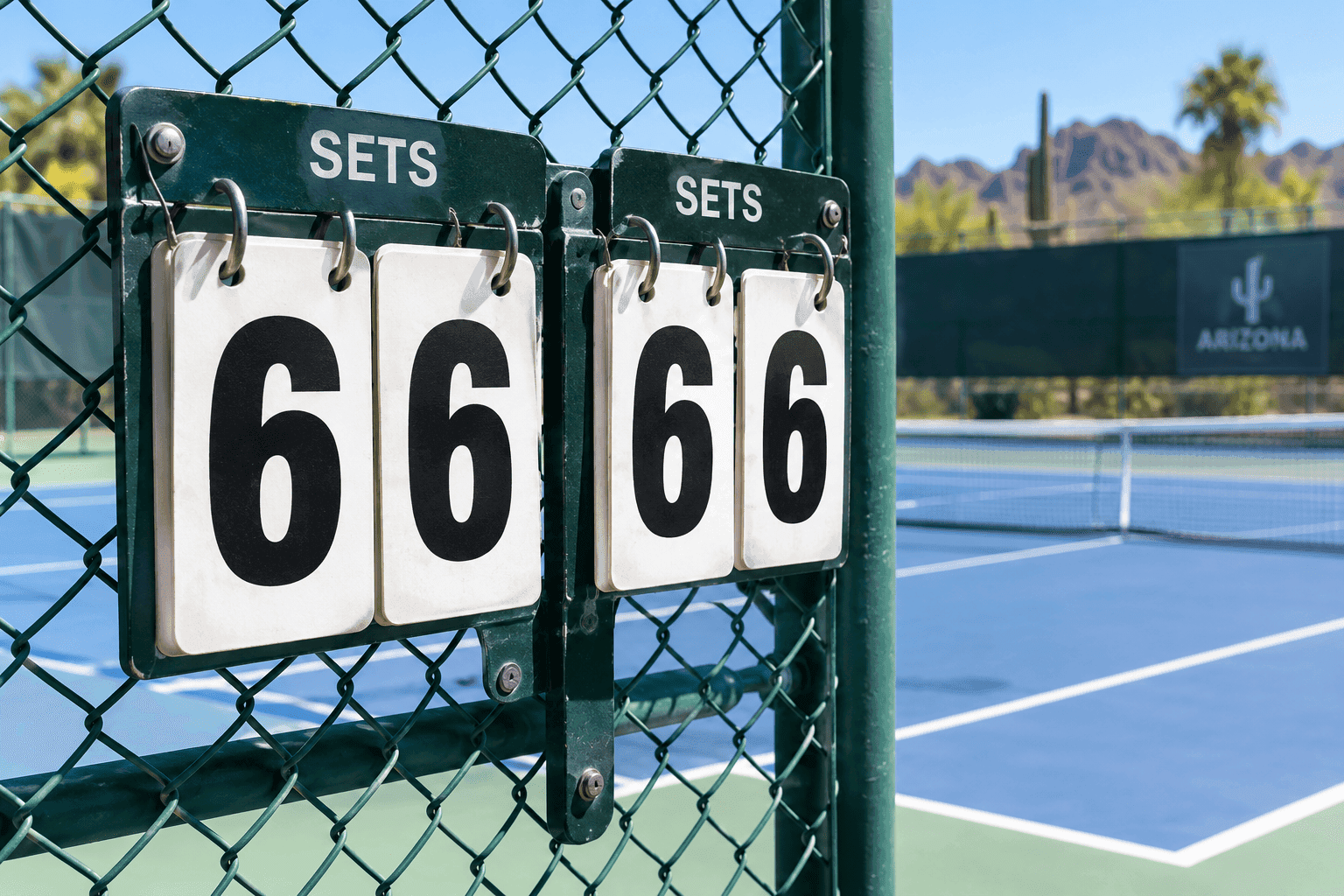
If you've ever watched a tennis match and wondered why the score went from 15 to 30 to 40, you're not alone.
Tennis scoring can seem strange when you're first learning the game. Then you hear someone say “Deuce,” “Advantage,” or “Love-30,” and it gets even more confusing.
The good news is that the basic system is actually pretty simple once you understand how the pieces fit together.
Tennis scoring has three levels:
Points → Games → Sets → Match
Win enough points to win a game. Win enough games to win a set. Win enough sets to win the match.
Let's break it down.
How Does Tennis Scoring Work?
In a standard tennis game, the points are called:
Love → 15 → 30 → 40 → Game
A player normally needs to win four points to win a game, but there is one important rule: they must be ahead by two points.
For example:
Win the first point: 15-0
Win the next point: 30-0
Win the next point: 40-0
Win the next point: Game
But if the score reaches 40-40, the game isn't over. That's when Deuce and Advantage come into play.
What Does "Love" Mean in Tennis?
Love simply means zero.
So if a player has won no points, their score is called Love.
For example:
Love-15 = 0-1
15-Love = 1-0
Love-30 = 0-2
30-Love = 2-0
You don't need to remember anything complicated here. Whenever you hear Love, think zero.
The Tennis Point Scoring System
Here's the basic sequence:
Points Won | Score Called |
|---|---|
0 | Love |
1 | 15 |
2 | 30 |
3 | 40 |
4 | Game, if ahead by two |
The important part is the last line.
If both players have won three points, the score is 40-40, which is called Deuce.
A Simple Way to Remember It
Don't spend too much time worrying about why tennis uses 15, 30, and 40.
You'll hear the sequence so often during actual play that it becomes natural:
Love → 15 → 30 → 40 → Game
The history behind tennis scoring is interesting, but you don't need to know it to play.
What Happens at Deuce?
Deuce means the players are tied after each has reached 40.
At this point, one player needs to win two points in a row to win the game.
Here's an example:
Deuce → Advantage → Game
If the player with Advantage wins the next point, they win the game.
But if they lose that point, the score goes back to Deuce.
For example:
Deuce
Player A wins the point → Advantage A
Player B wins the next point → Deuce
Player B wins the next point → Advantage B
Player B wins again → Game B
This can go back and forth several times.
What Does Advantage Mean?
After Deuce, the player who wins the next point gets Advantage.
There are two common ways you'll hear it announced:
Ad-In: The server has Advantage.
Ad-Out: The receiver has Advantage.
For beginners, you can simply think:
Advantage = one point away from winning the game.
If the player with Advantage wins the next point, they win the game.
If they lose it, you're back at Deuce.
Who Calls the Score in Tennis?
The server normally announces the score before each point, with the server's score stated first.
For example, if the server has won two points and the receiver has won one:
“30-15.”
If the receiver is ahead:
“15-30.”
This is a small habit, but it's worth learning early. Calling the score before serving helps both players know where they stand and avoids confusion during a match.
How Do You Win a Game?
In a normal game, you need to win at least four points and be ahead by two.
For example:
40-30 → win next point → Game
But:
40-40 → Deuce
From Deuce, you need to win two consecutive points.
That's the basic idea.
How Do You Win a Set?
Now let's move up one level.
A set is made up of games.
In the standard format, a player generally needs to win six games and be ahead by two games to win a set.
Examples:
6-0 → Set
6-2 → Set
6-4 → Set
6-5 → Not finished yet
7-5 → Set
So if the score reaches 5-5, one player needs to win the next two games to take the set 7-5, unless the competition uses a different set format.
What Happens at 6-6?
When a set reaches 6-6, a tiebreak is commonly played.
A standard tiebreak uses regular numbers rather than Love, 15, 30, and 40.
The goal is usually to reach 7 points and win by two.
For example:
7-5 → Tiebreak won
But if the score becomes:
6-6
the tiebreak continues until someone gets two points ahead.
So you could see:
8-6, 10-8, 12-10, and so on.
Some competitions use different tiebreak or final-set rules, so it's always worth checking the rules for the particular tournament or league you're playing.
How Do You Win the Match?
This depends on the competition.
A common format is best of three sets.
In that format, the first player to win two sets wins the match.
For example:
6-3, 6-4 → Player A wins in straight sets.
Or:
4-6, 6-3, 6-2 → Player A wins after three sets.
But not every tennis match follows exactly the same format. Junior events, leagues, tournaments, and recreational programs may use different scoring systems to keep matches shorter.
A Tennis Score Example From Start to Finish
Let's put everything together.
Imagine you're playing a singles match.
You win the first four points of a game:
15-0 → 30-0 → 40-0 → Game
You now lead the game 1-0.
You win another game:
2-0
Your opponent wins the next three:
2-3
You eventually bring the set back to:
5-5
You win the next two games:
7-5
You've won the set.
If the match is best of three sets, you now need to win one more set to win the match.
That's all the scoring system is doing—it's simply adding up points, games, and sets.
The Easiest Way to Learn Tennis Scoring
Reading about tennis scoring helps, but actually playing is what makes it click.
The first few times you play, don't worry if you have to stop and ask:
“What was the score?”
That's completely normal.
A good habit is to say the score before every serve. After a few practice matches, Love, 15, 30, 40, Deuce, and Advantage will start to feel like normal tennis vocabulary.
And once you understand the scoring, you can focus more on what really matters: getting to the ball, making good decisions, and building points.
Common Tennis Scoring Questions
1. Why is zero called Love in tennis?
Love is the traditional term used for zero in tennis. The exact historical origin of the term isn't completely settled, so you don't need to know its history to understand the scoring system.
2. What comes after 40 in tennis?
Normally, winning the next point after 40 wins the game if the player is already two points ahead. If the score is 40-40, it becomes Deuce, and a player must win two consecutive points to win the game.
3. What is Deuce in tennis?
Deuce is a tie at 40-40 in a standard game. From Deuce, a player must win two consecutive points to win the game.
4. What is Ad-In?
Ad-In means the server has Advantage after Deuce.
5. What is Ad-Out?
Ad-Out means the receiver has Advantage after Deuce.
6. How many games do you need to win a set?
In a standard set, you generally need to win six games and be ahead by two. If the score reaches 6-6, a tiebreak is commonly used.
7. How many sets do you need to win a tennis match?
It depends on the competition. In a best-of-three format, you need to win two sets. Other formats can use different scoring rules.
Ready to Put the Scoring Into Practice?
Once you understand the basics, tennis scoring isn't nearly as complicated as it first sounds.
The best way to learn is to get on the court and play a few points yourself.
At Team Hippa, our tennis programs give adult and junior players the opportunity to work on technique, movement, and real match situations. Our coaches can help you understand not only how to hit the ball, but also how to play and keep score confidently.